ORM
Object-relational mapping (ORM) is a programming technique that facilitates data conversion between incompatible systems using object-oriented programming languages. It allows developers to interact with a database using the programming language’s native syntax, making data manipulation more intuitive and reducing the need for extensive SQL queries.
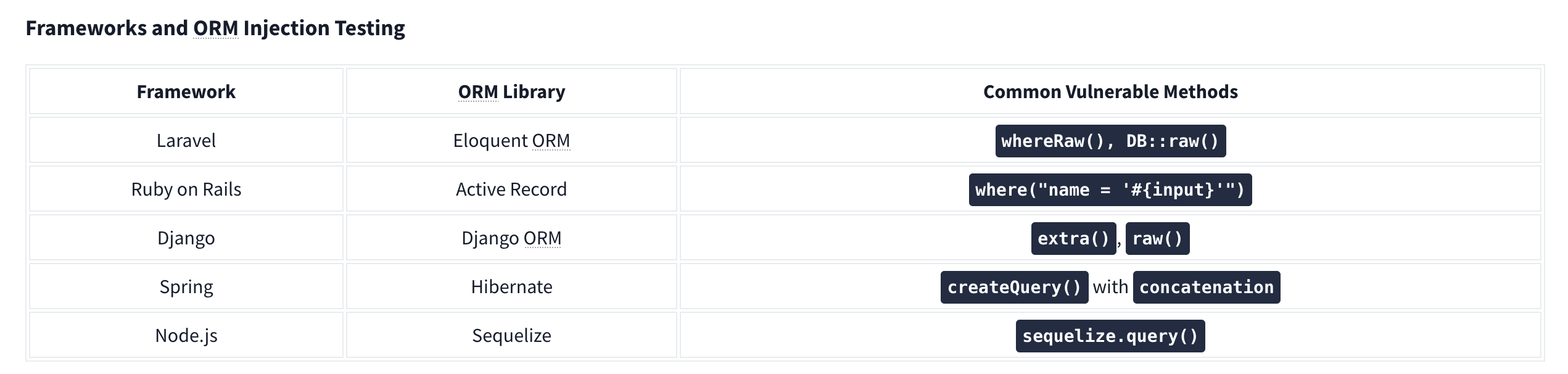
Commonly used ORM Frameworks:
- Doctrine (PHP)
- Hibernate (Java)
- SQLAlchemy (Python)
- Entity Framework (C#)
- Active Record (Ruby on Rails)
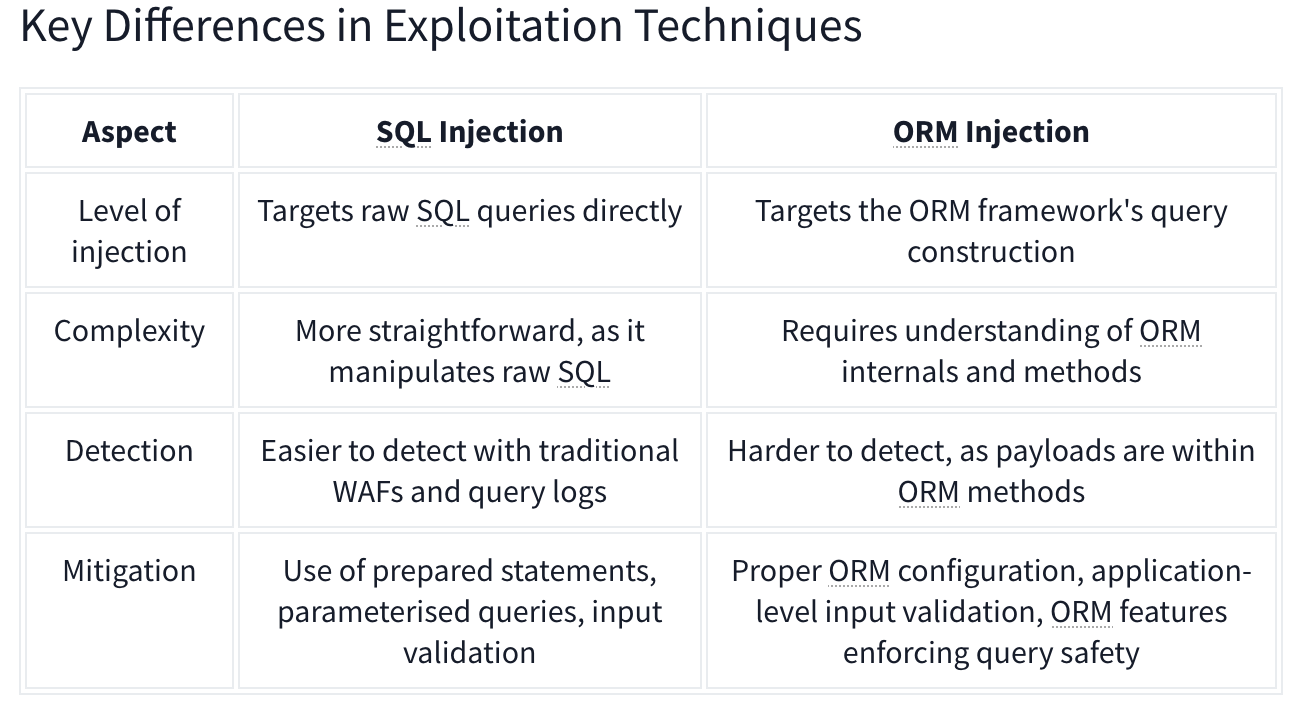
SQL Injection vs ORM Injection
SQL injection and ORM injection are both techniques used to exploit vulnerabilities in database interactions, but they target different levels of the stack:
- SQL injection: Targets raw SQL queries, allowing attackers to manipulate SQL statements directly. This is typically achieved by injecting malicious input into query strings. The injection part in the following query,
OR '1'='1, always evaluates to true, allowing attackers to bypass authentication:
SELECT * FROM users WHERE username = 'admin' OR '1'='1';
- ORM injection: Targets the ORM framework, exploiting how it constructs queries from object operations. Attackers manipulate the ORM’s methods and properties to influence the resulting SQL queries.
$userRepository->findBy(['username' => "admin' OR '1'='1"]);
CRUD Operations set up differently based on the Framework in use.
For example, Laravel uses the .env file to store environment variables such as database credentials.
Identifying Injection
Techniques for Testing ORM Injection:
- Manual code review
- Automated scanning
- Input validation testing
- Error-based testing
- Others:
- Checking the cookies which can use unique naming conventions.
- Also HTTP headers
- URL structure.
Check with similar techniques to SQL Injection such as '’s. Essentially ORM is used to help abstract SQL queries, making them more secure from SQLi, so for any exploitation to work it needs to be misconfigured or under-configured.